

A retinal tear is a small break in the retina, the light-sensitive layer at the back of the eye. It may not always cause pain, but it can lead to serious vision problems if left untreated. Getting the right treatment early can help prevent the tear from progressing to retinal detachment and reduce the risk of permanent vision loss.
Singapore has a high rate of myopia, which is an important risk factor for retinal tears and retinal detachment. According to the Ministry of Health, around 65% of children in Singapore are short-sighted by Primary 6, while about 83% of young adults are myopic (Ministry of Health, 2019). A population-based study also estimated that Singapore residents undergo an average of 10.5 retinal detachment operations per 100,000 people each year (Wong, Archives of Ophthalmology, 1999). These figures highlight why regular eye checks and early assessment of retinal symptoms are important, particularly for people with high myopia.
In this guide, we will explain the common causes and symptoms of a retinal tear, how it relates to other retinal diseases, and the treatment options available in Singapore. We will also cover what to expect during the procedure, how recovery typically progresses, and the warning signs that require urgent medical attention.
What Is a Retinal Tear?
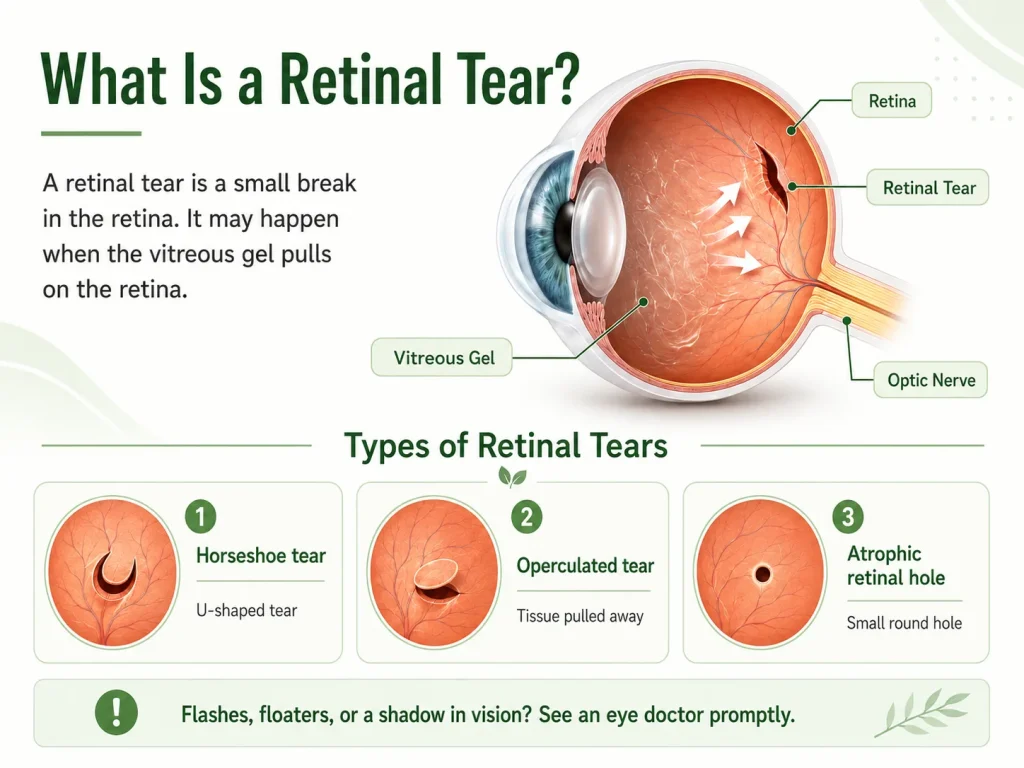
A retinal tear is a small break or split in the retina, the light-sensitive tissue at the back of the eye. It can occur when the vitreous gel pulls on the retina.
Types of Retinal Tears
Retinal tears can be classified into several types based on their shape and how they develop:
- Horseshoe tear: A U-shaped tear caused by strong vitreous traction.
- Operculated tear: A piece of retinal tissue is pulled away, leaving a flap.
- Atrophic retinal hole: A small, round opening that usually develops without significant vitreous pulling.
What Are the Symptoms of a Retinal Tear?
Generally, you may notice the symptoms below when you have a retinal tear. However, some people may not have any noticeable symptoms.
- Sudden floaters: You may notice new black spots, tiny dots, threads or cobweb-like shapes moving across your vision.
- Flashes of light: Brief flashes or flickers, especially at the side of your vision, can happen when the vitreous gel pulls on the retina.
- Blurred vision: Your vision may suddenly become less clear or distorted in the affected eye.
- Dark shadow or curtain: A growing dark area, curtain or veil across your vision can be a warning sign of retinal detachment and needs immediate medical attention.
- No symptoms: Some retinal tears cause no noticeable changes and are only found during a detailed eye examination.
Important: New or sudden floaters and flashes should not be ignored. An urgent eye examination can help determine whether a retinal tear or another retinal condition is present.
Need Help With Your Eye Health?
Speak with our eye specialist about your concerns and arrange an appointment.
What Causes a Retinal Tear?
Understanding the cause can help you recognise whether you may have a higher risk of developing a retinal tear. Several factors can make the retina more vulnerable:
Posterior Vitreous Detachment (PVD)
As we age, the vitreous gel inside the eye becomes more liquid and can pull away from the retina. This is called posterior vitreous detachment (PVD). Usually, it is harmless, but strong pulling can create a retinal tear.
High Myopia
People with high myopia have longer eyes, which can make the retina thinner and more vulnerable to tears. Myopia can also cause changes in the vitreous at a younger age, increasing the risk of retinal problems.
Eye Injury or Previous Eye Surgery
A strong blow or injury to the eye can damage the retina and cause a tear. Previous eye surgery, including cataract surgery, can also increase the risk in some people.
Other Risk Factors
Other factors can also increase the likelihood of a retinal tear. These include older age, a family history of retinal tears or detachment, a previous retinal tear or detachment, and lattice degeneration, where areas of the retina become thinner.
How Is a Retinal Tear Diagnosed?
If you have symptoms such as sudden floaters or flashes, an ophthalmologist will examine the retina carefully. Early diagnosis is important because a small tear can sometimes lead to retinal detachment.
Dilated Eye Examination
The main test for a retinal tear is a dilated eye examination. Eye drops are used to widen the pupil, allowing the ophthalmologist to examine the retina, including its outer edges where tears can occur.
Retinal Imaging
Additional imaging may be used when the doctor needs a closer look or cannot see the retina clearly. Optical coherence tomography (OCT) provides detailed images of the retina, while an eye ultrasound may help when bleeding or other problems block the view.
Follow-Up Examination
Sometimes, a retinal tear may not be visible during the first examination, particularly when vitreous changes are still developing. Your ophthalmologist may therefore recommend a follow-up examination if symptoms continue or your risk remains high.
A comprehensive eye screening in Singapore can also help identify retinal changes and other eye problems during a detailed examination.
Take the Next Step for Your Eye Health
Arrange a consultation with our eye specialist for a proper assessment.
Retinal Tear Treatment Options in Singapore
In Singapore, retinal tear treatment mainly includes retina laser treatment and surgery. The treatment recommended depends on the condition of the retina and whether the tear has led to a more serious problem.
1. Retina Laser Treatment
Retina laser treatment is commonly used to treat a retinal tear. The laser is used to seal the tear and help prevent it from progressing to retinal detachment. Early treatment can help protect the retina and reduce the risk of further vision problems.
2. Surgery
Surgery may be needed if the retinal problem has become more serious, such as when retinal detachment has occurred. A procedure called vitrectomy may be used to repair a detached retina and treat other serious retinal conditions.
The ophthalmologist will examine your eye and recommend the most suitable treatment based on your condition. At International Eye Clinic, our retinal care services include diagnosis and treatment for retinal conditions. You can learn more about our retina laser and retinal disease treatment services.
What to Expect During Retinal Laser Treatment
Retinal laser treatment is a short procedure, and you usually remain awake throughout. Here is what you can expect:
- Eye drops are given: Your pupil is widened with eye drops, and anaesthetic drops are used to numb the eye.
- You sit at the laser: The treatment is done while you are seated. You do not need to stay overnight.
- A special lens is placed: The doctor places a contact lens on the eye to focus the laser.
- The tear is treated: The doctor uses laser pulses around the retinal tear to seal the affected area.
- You go home: After a short rest, you can usually return home the same day.
You may see bright flashes during the treatment and feel some mild discomfort. The procedure usually takes only a few minutes.
Recovery After Retinal Laser Treatment
Recovery is usually quick, but your eye needs some time to heal fully. You may notice some temporary changes after treatment:
- Right after treatment: Your vision may be slightly blurred while the eye drops wear off.
- First few days: Most people can return to light daily activities within a day or two.
- During healing: The laser-treated area forms a scar that gradually becomes stronger over the following weeks.
- Physical activity: You may need to avoid heavy lifting, strenuous exercise and activities that could put stress on the eye for some time.
- Follow-up: Your ophthalmologist will check your eye to make sure the treated area is healing properly and that no new tears have developed.
If you notice new flashes, a sudden increase in floaters, a dark shadow or curtain, or loss of vision after treatment, seek urgent eye care.
How Much Does Retinal Tear Treatment Cost in Singapore?
The cost of treating a retinal tear depends on the procedure required, whether it is performed in a public or private setting, and the complexity of the case. Laser and freezing treatments are day procedures and cost considerably less than vitrectomy, which is performed in an operating theatre. The figures below are drawn from the Ministry of Health’s published hospital bill data and serve as a guide only.
Private and Public Treatment Costs
The table below shows typical transacted bill ranges by treatment and setting for Singapore Citizens.
| Treatment | Public (subsidised) | Public (non-subsidised) | Private hospital |
|---|---|---|---|
| Laser photocoagulation or cryotherapy for a retinal tear (day surgery) | $464 to $997 | $2,913 to $3,185 | $2,278 to $4,583 |
| Vitrectomy, simple (day surgery) | $1,672 to $3,159 | $7,401 to $9,546 | See note below |
Note: Figures are typical transacted bill ranges (25th to 75th percentile) for Singapore Citizens, inclusive of GST and before MediSave, MediShield Life, or insurance payouts (Ministry of Health, transacted 2023). Public subsidised amounts are after government subsidy. Sufficient private-hospital vitrectomy data was not published; for reference, MOH sets a private surgeon fee benchmark of $5,400 to $9,400 before GST for a simple vitrectomy, separate from hospital and anaesthetist charges. A specialist consultation with assessment generally costs $120 to $250 before any procedure.
MediSave, MediShield Life and Insurance
Laser photocoagulation, cryotherapy, and vitrectomy for retinal conditions are listed surgical procedures under MediShield Life and are claimable under MediSave, subject to the limits set by the Ministry of Health and the CPF Board (MediShield Life Claims Rules for Ophthalmology, 2026). MediShield Life is designed to cover most of a subsidised bill in a public hospital, leaving a smaller out-of-pocket amount. For treatment in a private hospital or as a private patient, an Integrated Shield Plan is usually required to cover a significant share of the bill, while MediSave may be used for the remaining portion up to the applicable surgical withdrawal limit.
Because MediSave withdrawal limits and MediShield Life claim limits are reviewed periodically, patients should confirm the current limits and their own coverage with their insurer and the clinic before treatment. Up-to-date bill sizes and procedure codes can be checked on the MOH Cost Financing portal.
Can Retinal Tears Be Prevented?
Retinal tears cannot always be prevented, because the vitreous changes that cause them are a natural part of aging. Risk can, however, be reduced, and tears can be caught early before they progress.
Protecting Your Eyes from Injury
Wearing appropriate eye protection during sports and other high-risk activities reduces the risk of trauma-related tears (Cleveland Clinic, 2023). Prompt attention to any eye injury is equally important.
Regular Eye Screening for High-Risk Individuals
Regular dilated eye examinations are the most effective safeguard, particularly for those with high myopia, a family history of retinal problems, or a previous tear. Early detection allows a tear to be sealed before it progresses. Booking a routine check with an eye specialist in Singapore is a straightforward way to stay ahead of retinal changes.
Have Questions About Your Vision?
Get professional advice and find out what your next step should be.
When Should You See an Eye Doctor Immediately?
If you suddenly notice new floaters, flashes of light, or a dark shadow or curtain across your vision, contact an ophthalmologist or eye specialist in Singapore immediately. These symptoms may be linked to a retinal tear or other serious eye problem. A retinal tear may not cause pain, so do not wait for pain before seeking medical attention.
Frequently Asked Questions
Do Retinal Tears Heal on Their Own?
Occasionally a small tear scars over without progressing, but this is uncommon and cannot be relied upon (Cleveland Clinic, 2023). Because the consequences of an untreated tear can be severe, ophthalmologists generally recommend treatment rather than waiting.
Is Retinal Tear Treatment Painful?
Laser and cryotherapy are performed after the eye has been numbed and are generally well tolerated. Patients may feel mild discomfort or see bright flashes during the procedure, but significant pain is uncommon.
How Successful Is Laser Treatment?
Laser photocoagulation is highly effective at sealing a tear and reducing the risk of detachment. It does not, however, eliminate all risk, and new tears can still form elsewhere in the retina, which is why follow-up remains important (National Eye Institute).
How Long Does Recovery Take?
Most patients recover from laser or cryotherapy within one to two weeks, with activity restrictions during that time. Recovery after vitrectomy is longer, and vision may take several weeks or months to settle (NYU Langone Health).
Can a Retinal Tear Come Back?
A treated tear is sealed permanently, but a new tear can develop in another part of the retina, especially in patients with high myopia or continuing vitreous changes. Ongoing monitoring helps detect any new tear early.
Medical Disclaimer:
This article is for general informational purposes only and should not replace professional medical advice, diagnosis, or treatment. If you experience sudden changes in vision, new flashes or floaters, or a dark curtain or shadow across your vision, seek medical attention promptly.
References and Medical Sources
- Ministry of Health Singapore (2019). Myopia prevalence in Singapore. https://www.moh.gov.sg/newsroom/speech-by-dr-lam-pin-min-senior-minister-of-state-for-health-at-the-opening-of-the-singapore-national-eye-centre-s-myopia-centre-16-august-2019/
- Wong TY (1999). Racial difference in the incidence of retinal detachment in Singapore. Archives of Ophthalmology. https://pubmed.ncbi.nlm.nih.gov/10088817/
- National Eye Institute. Laser Surgery and Freeze Treatment for Retinal Tears. https://www.nei.nih.gov/learn-about-eye-health/eye-conditions-and-diseases/retinal-detachment/laser-surgery-and-freeze-treatment-retinal-tears
- American Academy of Ophthalmology. What Is a Torn Retina? https://www.aao.org/eye-health/diseases/what-is-torn-retina
- Mayo Clinic (2024). Retinal detachment: Diagnosis and treatment. https://www.mayoclinic.org/diseases-conditions/retinal-detachment/diagnosis-treatment/drc-20351348
- Cleveland Clinic (2023). Retinal Tear. https://my.clevelandclinic.org/health/diseases/25107-retinal-tear
- NYU Langone Health. Procedures to Treat Retinal Tears and Retinal Detachments. https://nyulangone.org/conditions/retinal-detachment/treatments/procedures-to-treat-retinal-tears-retinal-detachments
- Ministry of Health Singapore. Cost Financing: hospital bills and fee benchmarks (transacted 2023). https://www.moh.gov.sg/managing-expenses/bills-and-fee-benchmarks/cost-financing/
- Ministry of Health Singapore. SL800V Simple Vitrectomy: bill information. https://www.moh.gov.sg/managing-expenses/bills-and-fee-benchmarks/cost-financing/tosp-sl800v-bill-information/
- Ministry of Health Singapore / CPF Board. MediShield Life Claims Rules for Ophthalmology (updated 2026). https://isomer-user-content.by.gov.sg/95/20793f9e-b660-46c4-b1d6-6f731897a4b0/MSHL%20Claims%20Rules%20for%20Ophthalmology%20(updated%202026).pdf
